

Among the different stages of chocolate production, roasting is often cited as an example. There are two reasons for this. Firstly, most chocolate producers work far from cocoa plantations. They only apply their expertise from this stage onwards. Secondly, calling oneself a "chocolatier-roaster" distinguishes oneself from so-called classic chocolatiers, who only work with couverture chocolate, without processing the cocoa themselves. But, ultimately, why do we roast cocoa?
Physico-chemical necessity
Roasting cocoa influences its physical and chemical properties. On the one hand, roasting makes it easier to remove the skin from the cocoa bean, which can then be discarded. Otherwise, the texture of the chocolate would change. Paradoxically, and contrary to what many artisanal roasters believe, roasting does not significantly reduce the moisture content of the beans. This rate is primarily dependent on the drying of the beans in the cocoa-producing country.
On the other hand, roasting also influences the molecules of cocoa. It thus has an effect on its taste. The most impactful phenomenon at this stage is called the Maillard reaction. Distinct from caramelization, this reaction is typical of cooking phenomena that enhance the taste and aroma of food. In the case of cocoa, this step will have several actions. Firstly, it changes the color of the cocoa. Going from light brown to chocolate brown, the bean thus acquires its iconic hue. Secondly, the taste gains intensity, particularly in astringency. Indeed, changes in the concentration of antioxidants play a role in this variation of color and taste.
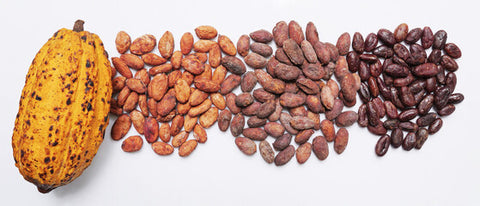
From left to right, cocoa pod, raw cocoa, roasted cocoa and roasted without its skin. Credit: Chansom Pantip.
Roasting cocoa, a crucial step and a unique savoir-faire
On paper, everything seems clear. Yet, finding the right balance requires a lot of practice. Too much roasting makes the cocoa bitter, even burnt. Not enough, and it will lack intensity. This step allows the chocolatier to impart their style to the cocoa. The process is also more complex than it seems. Some cocoas are particularly sensitive and cannot tolerate more than a few tens of seconds before being over-roasted.
Temperature, duration, air humidity, and the size and type of cocoa beans determine the precise characteristics of roasting. Generally, for cocoa, the Maillard reaction only begins above 100°C and is most effective above 130°C. This is why roasters often vary the temperature over time. This allows them to bring out the best in the cocoa, while ensuring uniform roasting despite the relative diversity of the beans. Lighter roasting brings out more of the cocoa's fruity aromas, while stronger roasting emphasizes more intense and umami notes.

Comparative table of different roasting conditions for three different cocoas. It is particularly interesting to note for the 2nd cocoa, the significant change in composition when moving from a roasting temperature of 120°C to 135°C. Credit: Joanna Oracz & Ewa Nebesny.
Thus, when an artisan indicates a type of roasting—light, intense—or even a temperature and duration, they are not revealing their secret. Indeed, without further details, it is hardly possible to make anything of it. On the other hand, by doing so, they not only highlight their work but also facilitate comparison and understanding for the consumer.
Roasted, raw or pasteurized cocoa
Roasted chocolate is often contrasted with so-called raw chocolate. However, if the cocoa used to produce these chocolates is not roasted, it does not mean that it has not been heated during fermentation, and then to be processed into a liquid chocolate mass.
Conversely, the cocoas processed by industrial manufacturers are rarely roasted. More often pasteurized than roasted. Indeed, to get rid of molds and bacteria from these cocoas, companies briefly heat the beans to high temperatures, several hundred degrees. While it guarantees the food safety of cocoa, this method destroys the most volatile components that make up the subtle taste of quality artisanal chocolates.
The sommelier's note (Nicolas) Personally, asking questions about cocoa roasting is an excellent way to ensure that your interlocutor genuinely makes their chocolate from bean to bar. Over time, you will also be able to identify which style suits you best. To delve deeper, particularly into technical details, this scientific article published by two researchers in the journal European Food Research and Technology in 2018 is full of information.
Find the original article on Nicolas' delicious blog.


Comments