

Nestlé, Cailler, and Lindt are the names associated with chocolate in Switzerland. However, the invention of milk chocolate, the quintessential emblem of Swiss chocolate, was not achieved by any of them. The credit goes to Daniel Peter. An invention that will celebrate (more or less) its 150th anniversary in 2025.
It all began with an intuition. A candle maker in Vevey, Daniel Peter quickly realized that the advent of gas lighting signaled the decline of his business. Married to the daughter of a certain Cailler, he saw the potential of milk chocolate, a Swiss emblem. However, this popular product remained a beverage, which complicated its large-scale commercialization. Indeed, at the time, milk could only be consumed fresh.
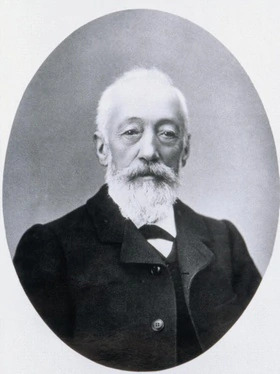
Credit: Chocosuisse.
Swiss Milk Chocolate, an American Invention?
It was thanks to an American, Gail Borden, that the Swiss Daniel Peter was able to make milk chocolate commercially viable on a large scale by making it portionable and transportable. Indeed, shortly before Peter's experiments, the American invented condensed milk. This process finally allowed milk to be preserved for longer. The product quickly gained popularity, and various factories were built around the world, including in Switzerland.
In Switzerland, Peter sensed the product's potential and began by using condensed milk to create a cocoa paste with milk. Then, through extensive experimentation, in 1885, he managed to create a milk powder that he was able to incorporate into cocoa. By adding sugar to balance the bitterness of the cocoa, as well as salt and baking soda, he created solid discs. Tablet milk chocolate was born, except it was then called "croquettes."
Its success was dazzling. From a few employees in 1890, the factory grew to over 1,000 people ten years later. This success was based on a keen business sense. Indeed, Peter registered the trademarks of his chocolates, including Gala Peter, which replaced the famous croquettes. Thanks to marketing targeting tourists, to whom he presented his creations as typically Swiss, he rapidly expanded his business.

D.Peter, Gala Peter Milk Chocolates
Credit: Chocosuisse.
But competition was fierce. Between employees selling his manufacturing secrets and the development of other chocolate manufacturers, he ended up associating with other names in "classic" chocolate. First Kohler, then Cailler. Finally, the 1929 crisis brought the conglomerate back into Nestlé's fold. Gala chocolate was marketed under that name until the 1980s.
Who is the inventor?
This story, full of twists and turns, had a more recent episode in 2016. A Mr. Peter, with no direct ties to the original inventor, re-registered the Peter brand in connection with chocolate. Asserting his right, he decided to sue Cailler and Nestlé when they (abusively) boasted in an advertisement of being the originators of milk chocolate.
The multinational's response: by marrying a Cailler daughter, Daniel Peter was part of the clan. So, saying that a "Cailler" invented milk chocolate is nothing more than an inclusive approach... This goes to show that alternative facts are not solely the preserve of politicians. This legal episode regarding the paternity of milk chocolate's invention primarily reveals the strength of Swiss chocolate: a relentless, if not aggressive, commercial positioning. A trend that continues to this day. And this despite the fact that industrial chocolate associated with Switzerland is less and less produced in the country, or with less and less Swiss milk in favor of "alpine" milk, which includes, for example, Slovenia.
Renewal of Swiss Chocolate Inventions
Ultimately, two elements define the strength and reputation of the Swiss milk chocolate invention. On the one hand, the valorization of a product associated with Alpine folklore, milk, and on the other hand, the technological innovation that allows its virtues to be shared with the widest audience. Nothing very mysterious, yet the concept resonates with the current bean-to-bar movement, which tends to return to simple ingredients, including Swiss milk.
Today, Switzerland lags behind in the bean-to-bar movement. Many Swiss chocolates are very (too?) classic. However, a potential renewal could materialize by reconnecting with technological innovation. Indeed, several scientific institutions are working together with companies to create new products. And ideas are not lacking. Local alternatives to cocoa or the extraction of cocoa aromas with water rather than by roasting.
The nagging question remains: does the "Swissness" of chocolate lie in artisanal know-how, as advertising claims, or rather in an industry formidable in its creativity to invent globally successful products? It's up to you to judge.
Find the original article on Les Chocolats de Nicolas


Comments