

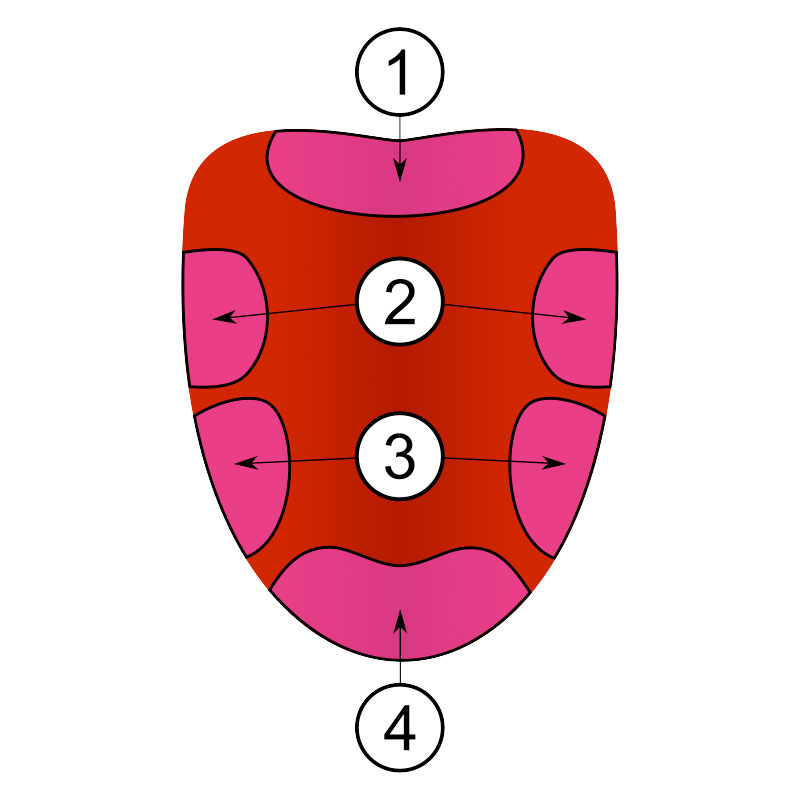
Sweetness at the tip, bitterness at the back, etc. However, the tongue's taste map for tasting is a myth. Born at the beginning of the last century, the theory of specific zones for basic tastes – sweet, salty, bitter, and sour – was appealing. Nevertheless, the idea did not stand up to testing. Unfortunately, the concept remains popular with the general public and continues to be used incorrectly. With the popularization of the sixth taste, umami, the phenomenon has intensified. Should we, however, abandon the idea of mapping our tongue when tasting chocolate?
A taste map for each chocolate?
While tastes are perceived across the entire tongue, identifying how different perceptions related to a particular food occur remains interesting. Indeed, when tasting chocolate, it quickly becomes apparent that the mouth reacts in a spatialized way. Each bar produces identifiable sensations in different zones. Thus, some chocolates have peppery notes on the tip of the tongue, the apex. Others have an astringent sensation on the inside of the cheeks or at the back of the throat.
In addition to localization in the mouth, the sensation is also described over time. Certain aromas and sensations appear fleetingly as the chocolate develops its taste profile. These dynamic impressions can reinforce or, on the contrary, diminish spatial perceptions. Furthermore, perception can vary from person to person, but also according to the context. Therefore, should we abandon any idea of being able to benefit from a taste map, even for a given chocolate? Not completely.
A mental map
Establishing a personal mental map of a chocolate's tastes is nonetheless worthwhile. Indeed, this approach makes it easier to gain tasting experience. While some aromas are easy to identify and a visual guide can help, the brain often works by association. Thus, by mentally noting recurring elements beyond tastes, it is easier to remember and identify them later.
This important role of different memories makes it easier to compare different chocolates, particularly in the context of evaluations. Similarly, this approach also allows for faster identification of a new sensation. From there, it is gradually possible to describe the new sensation and finally name it. A process that seems very artificial when described in this way, but which occurs very naturally once the mechanism is well-practiced.
Ultimately, it is personally interesting and fun to map one's own sensitivities. By doing so, it is possible to understand positive and negative biases towards specific sensations. A rather pleasant conclusion, as it implies that we must taste chocolate again and again to keep our mental map up to date. Who wants more chocolate?
Re


Comments