

In addition to milk chocolate, here is another Swiss invention: conching. But what is this process used for and how does it work? In chocolate making, it comes after roasting and is distinct from grinding cocoa beans to turn them into cocoa paste. Thus, it is entirely possible to produce so-called un-conched chocolate. It will still be chocolate as long as sugar is added to the coarsely ground cocoa mass. But then, what is conching?
What is the impact of conching on the taste and texture of chocolate?
Conching refines the taste and texture of chocolate during its production. By continuing to grind the cocoa, the process produces particularly smooth chocolates. Through prolonged work, the granulometry of the mixture decreases until no texture can be felt, making it perfectly homogeneous. Another element comes into play regarding taste. Indeed, due to friction, the mixture heats up. The temperature then rises to between 50 and 90°C. This allows some volatile components, such as acetic acid, to evaporate. The goal is to enhance the chocolate notes and reduce the more acidic ones.
It is important to know that these are taste interpretation choices specific to the chocolate producer. Maintaining certain notes or changing their balance does not necessarily mean better or worse chocolate. Thus, thanks to roasting, which allows playing with some of these same flavors, it is possible to produce an unconched chocolate that is just as rich in taste.
What are the types of conching?
There are different conching processes. Legend has it that the mills grinding the cocoa were left running over a weekend. Thus, upon his return, the fortunate (sic) Rudolph Lindt supposedly found a smooth liquid mass. Even today, it is possible to leave a mill running for several days to achieve this result. This is known as dry or long conching. In addition to changing the taste and consistency, this approach reduces the moisture level of the mixture, which improves the shelf life of the chocolate.
Complementary to this original approach, liquid conching involves continuing to agitate the cocoa mass, but with the addition of cocoa butter or any other fat. This makes the mixture more fluid, resulting in an even silkier product. It is also at this point that some producers add different elements to their mixture, such as vanilla or spices. This allows for a more uniform infusion.
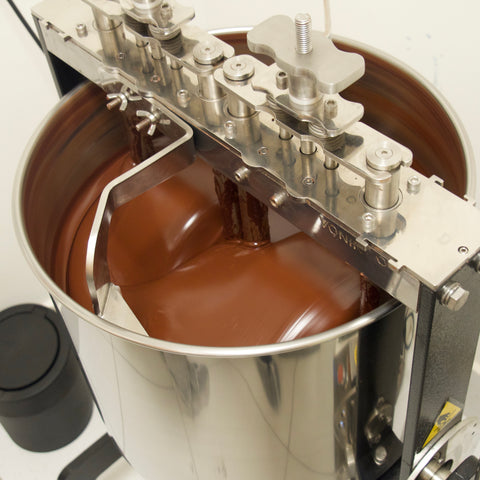
Liquid conching at Ecuacao
Non-traditional conching methods
Paradoxically, there is also wet conching. This method involves adding a little water to the cocoa mass. This process shortens the conching time by releasing volatile compounds more quickly, while partially limiting the temperature rise. The resulting chocolate is generally less smooth and has fewer chocolate notes. The recipes for wet conching, which are closely guarded secrets, walk a fine line. Indeed, the fat naturally present in cocoa tends to separate from the water. The mass is therefore less stable and more difficult to work with.
Finally, it is also possible to carry out cold conching. This involves performing the same operation, but avoiding any significant temperature increase. The goal is to retain the volatile acidic elements while working on the texture. Due to its technical complexity, this method is generally not very widespread.
Conche or mixer
Often presented as queen, the longitudinal conche is the heir to the glorious years of the pioneers of the chocolate industry. Inspired by traditional indigenous artisanal methods, this conche consists of a basin with a curved stone bottom in which a roller moves back and forth. Directly adapted from the mechanisms of the industrial revolution, the whole is driven by a wheel reminiscent of the back-and-forth motion of the mechanical arm activating the wheels of steam locomotives. Currently, modern versions are powered by an electric motor and are much more compact. But they remain very expensive.

Small 3 kg mixer
Due to lack of resources, bean-to-bar manufacturers often opt for simplicity. They perform their conching in the mill that grinds the cocoa beans and consists of two stone wheels rotating in a circle. Sometimes, they use a second mill as a specific mixer. Due to the quantity of chocolate in contact with the grinding wheels, the process makes it more difficult to control the temperature of the mixture. The artisan's work, which consists of adjusting the speed and duration, is all the more important.
Metal ball mixers overcome these constraints. Indeed, these more sophisticated machines allow the temperature of the mixture to be controlled thanks to a cooling and heat evacuation system. Moreover, unlike stone grinders, metal conducts heat well, allowing for more precise adjustments. However, these machines remain expensive, even prohibitive for small artisans, especially in cocoa-producing countries wanting to make their own chocolate.
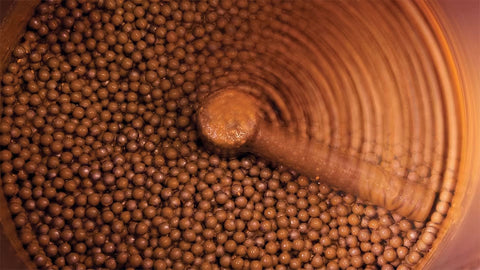
Conching in a ball mill. Credit: Selmi.
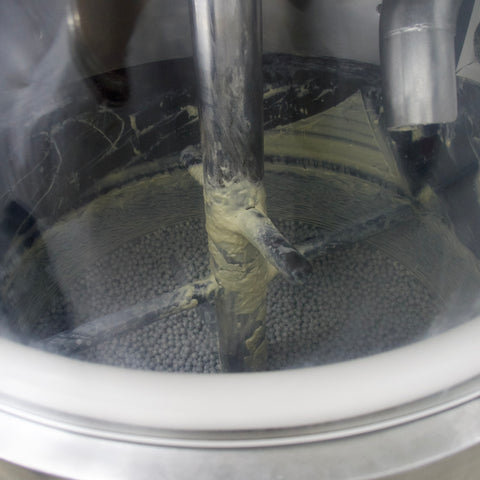
Conching in a ball mill
Chocolate conching: for or against?
Ultimately, is conching absolutely necessary for good chocolate? No. Is it another arrow in the producers' quiver? Definitely. Lately, it's particularly interesting to observe how many boundaries are blurring. Thanks to the revival of bean-to-bar chocolate and the inventiveness of producers, mixers are used for conching, while others produce unconched chocolate. The range of experiences is thus expanded. It's then up to each individual to decide their preferences. It's especially important to break free from the standards inherited from the very industrial past to discover new taste sensations.
And what do you think of conching?


Comments